Ankle Pain: Common Causes, What Your Body Is Telling You, and When to See a Podiatrist
Ankle pain is one of those complaints that people tend to dismiss too easily. You rolled it slightly during a walk, or it's been aching after long days at work — surely it will sort itself out? Sometimes it does. But ankle pain that keeps coming back, lingers beyond a couple of weeks, or occurs without any obvious injury is your body signalling that something more persistent is happening. Understanding ankle pain causes, treatment in Mumbai, and when professional assessment is genuinely needed can make the difference between a swift recovery and months of chronic discomfort.
The ankle is a remarkably complex joint. It handles everything from walking on flat office floors to navigating Mumbai's uneven footpaths, and it absorbs significant force with every step. When it starts hurting, the reason can range from a ligament sprain to a tendon problem, from flat feet subtly pulling the joint out of alignment to early arthritis building up silently. This guide walks through the most important causes, what each one feels like, and what a podiatric approach to ankle pain actually involves.
Understanding the Ankle Joint: More Complex Than It Looks
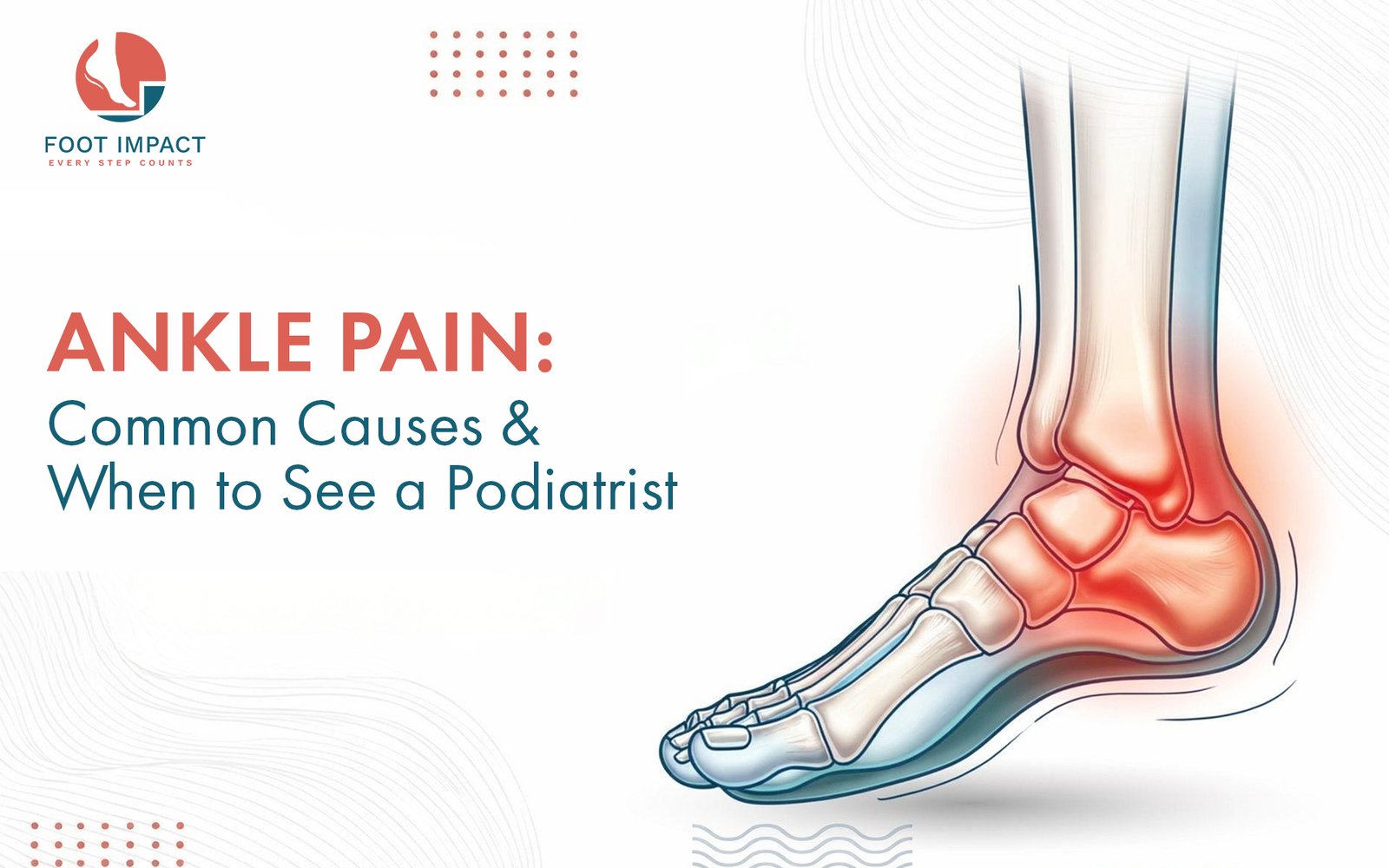
The ankle joint sits at the meeting point of three bones: the tibia (shin bone), fibula (outer lower leg bone), and talus (the uppermost foot bone). These are held together by a network of ligaments and supported by several tendons — most notably the Achilles tendon behind the heel and the peroneal tendons running along the outer ankle.
What makes ankle pain particularly tricky to self-diagnose is that pain on the inside, outside, front, or back of the ankle can each point to very different underlying problems. Location matters enormously. A podiatrist assessing ankle pain will always ask not just where it hurts, but when — morning versus after exercise, with specific movements or constantly — because these patterns are clinically significant.
The ankle bears approximately 1.5 times your body weight during normal walking — and up to 5–8 times during running. Small mechanical imbalances in the foot below translate directly into altered load patterns at the ankle.
The Most Common Causes of Ankle Pain
1. Ankle Sprains and Chronic Ankle Instability
The lateral ankle sprain — where the foot rolls outward and the outer ligaments stretch or tear — is the single most common ankle injury across all ages and activity levels. Most people know they've sprained an ankle when it happens: there's a sharp twist, immediate pain, and swelling that develops within hours.
What's less well understood is what happens next. A mild sprain may heal uneventfully with rest and ice. But a significant sprain where the ligament is genuinely torn, or a series of repeated minor sprains, leaves the ankle in a state of chronic instability. The proprioceptive receptors in the ligament — the microscopic sensors that tell your brain where your ankle is in space — are damaged. The ankle becomes mechanically unreliable and physiologically less aware of its position, making further sprains far more likely.
Chronic ankle instability is one of the most common reasons people seek ankle pain treatment in Mumbai at podiatry clinics. It responds well to rehabilitation and orthotic intervention — but it does not resolve by simply resting and waiting.
2. Flat Feet and Overpronation
This is one of the most important and most overlooked connections in foot and ankle health. When the arch of the foot collapses — either habitually (flat feet) or dynamically during walking (overpronation) — the talus tilts inward. This inward tilt is transmitted directly to the ankle joint, causing the ankle to rotate in a way it wasn't designed to sustain for hours every day.
The result is a chronically stressed medial (inner) ankle. Patients often describe a dull ache on the inside of the ankle and into the arch, worst after long periods of standing or at the end of an active day. Because the cause is biomechanical rather than traumatic, rest provides only temporary relief — the ankle returns to the same stress the moment activity resumes.
Our flat feet assessment and treatment service at Foot Impact uses computerised pressure mapping to identify exactly how your foot is loading, and whether overpronation is driving your ankle symptoms.
3. Achilles Tendinopathy
The Achilles tendon — the largest tendon in the body — attaches the calf muscles to the heel bone and passes directly behind the ankle. When this tendon becomes inflamed or degenerates through overuse (as in Achilles tendinopathy), it produces pain that is typically felt at the back of the heel and lower ankle. Morning stiffness, pain after prolonged sitting, and discomfort that initially eases with movement but worsens after exercise are the hallmark features.
Achilles tendinopathy is increasingly common in adults who have recently started exercising more, returned to sport after a break, or have been standing for long hours in unsupportive footwear. Without proper treatment, the tendon fibres gradually degrade further, and the risk of a complete rupture — a serious and debilitating injury — increases.
4. Peroneal Tendinitis
The peroneal tendons run along the outside of the ankle and play a key role in stabilising the foot and preventing inversion (rolling outward). When overloaded — typically through repetitive sports or sudden increases in activity — they become inflamed and produce pain along the outer ankle and heel. The pain is often described as a burning or aching sensation that worsens with walking, running, or prolonged standing.
Peroneal tendinitis is frequently mistaken for a lateral ankle sprain, particularly in the early stages. However, the key distinction is that tendinitis pain is typically more localised along the line of the tendon, rather than concentrated at the ligament attachment points.
5. Ankle Osteoarthritis
Arthritis of the ankle is less common than hip or knee arthritis, but when it occurs, it is often the result of previous trauma — a poorly healed fracture, chronic instability that gradually eroded the joint cartilage, or long-term biomechanical overloading. Ankle arthritis presents as deep, aching pain, morning stiffness that eases after moving around, and a gradually reducing range of ankle motion. Swelling around the joint after activity is also common.
Importantly, conservative podiatric management with offloading orthotics, footwear modification, and gait retraining can significantly reduce the symptoms of ankle arthritis and slow its progression — making early podiatric assessment genuinely valuable.
6. Ankle Pain Without Injury: Referred and Systemic Causes
One of the most confusing presentations is ankle pain that develops without any identifiable injury. Patients often report a gradual onset of pain that they can't attribute to a fall, roll, or sporting incident. In these cases, the cause is often one of the following:
Referred pain from lower back or hip biomechanical dysfunction — nerve irritation higher up the chain can present as foot or ankle pain
Gout — uric acid crystal deposition in joints; classically affects the big toe but can occur in the ankle
Rheumatoid arthritis — an autoimmune condition that frequently affects multiple joints including the ankles
Tarsal tunnel syndrome — compression of the tibial nerve as it passes through the inside of the ankle, producing burning or shooting pain
If your ankle pain appears without a clear mechanical cause, or is accompanied by significant swelling, warmth, redness, or systemic symptoms, always seek medical assessment. These features may indicate an inflammatory or systemic condition that requires investigation beyond foot and ankle biomechanics alone.
Ankle Pain by Location: A Quick Diagnostic Guide
How Foot Alignment Drives Ankle Problems
One of the most important insights in podiatry is that ankle pain very rarely starts at the ankle. The foot is the foundation — and when the foundation is misaligned, the ankle joint above it pays the price over time.
Consider the mechanics: if your foot rolls inward excessively with every step (overpronation), the ankle absorbs a rotational force it was not designed to handle repeatedly for thousands of steps per day. Over weeks and months, this cumulative stress inflames tendons, strains ligaments, and erodes joint cartilage — all without a single traumatic incident.
The reverse is also true. A high-arched foot (cavus foot) that underpronates places excessive load on the outer ankle and is a significant risk factor for lateral ankle sprains and peroneal tendinitis.
This is why our computerised gait and posture analysis is central to ankle pain assessment at Foot Impact. Without understanding how your foot is actually moving, any ankle treatment is addressing the symptom rather than the source.
When Should You See a Podiatrist for Ankle Pain?
Not every ankle twinge demands an immediate appointment, but there are clear signals that professional assessment is the right move — and delaying tends to extend recovery time significantly.
See a Podiatrist If:
Ankle pain has persisted for more than two weeks despite rest
You have experienced repeated ankle sprains — more than two in a year
Pain is occurring without any obvious injury or trauma
You notice the ankle feels unstable or "gives way" during walking
Pain is affecting your sleep, daily activity, or exercise
There is visible deformity, significant swelling, or the ankle cannot bear weight
You have diabetes, peripheral neuropathy, or poor circulation — any ankle problem in this context requires prompt professional review
Don't Wait If:
Ankle pain follows a significant fall, sporting collision, or high-impact incident — a fracture must be ruled out
Swelling is severe and appeared within minutes of an injury
You cannot bear weight on the foot at all
The ankle appears visibly deformed or displaced
A useful clinical rule: if you cannot take four weight-bearing steps on the affected foot immediately after an ankle injury, the Ottawa Ankle Rules — a validated clinical guideline — recommend imaging to exclude a fracture. When in doubt, get it checked.
How Podiatrists Diagnose and Treat Ankle Pain in Mumbai
When you present to Foot Impact with ankle pain, the assessment is comprehensive and built around understanding why the pain is occurring — not simply where.
Detailed clinical history: Duration, mechanism (if any), timing of pain, aggravating and relieving factors, footwear habits, occupational demands, and activity levels are all documented.
Physical examination: Assessment of ankle range of motion, joint stability tests, ligament integrity, tendon palpation, and swelling assessment.
Computerised gait analysis: Real-time foot pressure mapping and motion analysis to identify biomechanical drivers — overpronation, supination, asymmetries in load distribution that are contributing to ankle stress.
Foot structure assessment: Arch type, hindfoot alignment, and the relationship between the foot, ankle, and lower limb are evaluated as an integrated system.
Footwear review: Your current footwear is assessed for support levels, heel counter integrity, and suitability for your foot type and daily demands.
Treatment Options at Foot Impact
Based on the diagnosis, a personalised treatment plan is built. This may include one or more of the following:
Custom Orthotics
For biomechanically driven ankle pain — which accounts for the majority of chronic ankle complaints — custom foot orthotics are the cornerstone of treatment. By controlling how the foot moves during each step, they eliminate the rotational stresses being transmitted to the ankle. Custom orthotics at Foot Impact are designed specifically from your pressure mapping data, not from a generic mould.
Explore our custom orthotics and insole service and how they are prescribed as part of a comprehensive biomechanical plan.
Footwear Guidance
The right shoe for someone with flat feet and medial ankle pain is fundamentally different from what works for someone with high arches and lateral instability. Podiatrist-led footwear advice is specific, not generic — and it can often achieve significant symptom improvement without any other intervention.
Rehabilitation and Strengthening
For ankle instability, tendinopathy, and post-sprain rehabilitation, a structured programme of proprioceptive training, calf and ankle strengthening, and progressive loading is prescribed. The goal is not just pain relief but restoring the ankle's mechanical competence and reducing re-injury risk.
Offloading and Bracing
For acute or severe tendinopathy, stress responses, or post-surgical care, appropriate offloading devices, padding, or bracing may be recommended to allow healing while maintaining as much function as possible.
Preventing Ankle Pain: Practical Steps for Everyday Life
Once ankle pain has been properly assessed and treated, the priority becomes preventing recurrence. The following measures are consistently recommended by podiatrists for anyone with a history of ankle problems or biomechanical risk factors:
Wear supportive footwear with adequate heel counter and arch support — avoid flat, unsupported chappals for prolonged use
Replace athletic shoes every 500–600 km, or sooner if heel wear is visible — worn midsoles no longer provide adequate ankle support
Stretch calf muscles and Achilles tendon daily, particularly before and after activity
Strengthen ankle-stabilising muscles with balance exercises such as single-leg standing progressively moving to unstable surfaces
If you have known flat feet or high arches, wear prescribed orthotics consistently — not just when pain is active
Avoid prolonged barefoot walking on hard floors, particularly if you have flat feet or a history of ankle problems
If your work involves prolonged standing — as a teacher, retail professional, healthcare worker, or in a factory environment — ask about our podiatry assessment for occupational foot and ankle pain. Simple workplace footwear and orthotic adjustments frequently produce dramatic improvements in daily comfort and long-term joint health.
Frequently Asked Questions About Ankle Pain
Q1. Can flat feet really cause ankle pain if I've never had a sprain?
Absolutely — and this is one of the most common presentations in podiatry clinics. Flat feet cause the ankle to rotate inward with every step. Over months and years, this chronic rotational stress inflames the tendons and ligaments that support the inner ankle, without any single injurious event. Patients often describe a gradual onset of medial ankle aching that they cannot attribute to anything specific. The cause is biomechanical, and it responds well to orthotic correction.
Q2. My ankle keeps giving way even though I have rested it for months. Why isn't it healing?
A feeling of the ankle giving way or being unreliable is the hallmark of chronic ankle instability. This occurs when the proprioceptive nerve fibres in damaged ligaments do not fully regenerate — the brain loses accurate real-time information about ankle position. Rest alone does not restore proprioception. A structured rehabilitation programme and, where indicated, orthotic support to control excessive motion during activity are needed to properly resolve this.
Q3. Is ankle pain from arthritis treatable without surgery?
In the majority of cases, yes. Conservative management through custom orthotics, footwear modification, activity adjustment, and anti-inflammatory strategies can significantly reduce pain and improve function in ankle arthritis. Surgery is typically reserved for cases where conservative management has been properly tried and has not provided adequate relief. Early podiatric intervention is therefore strongly worthwhile — the sooner the joint loading is optimised, the slower the arthritic progression tends to be.
Q4. What is the difference between ankle tendinitis and a sprain?
A sprain is an injury to a ligament — the tough, fibrous connective tissue that connects bone to bone and limits excessive joint motion. Tendinitis is inflammation of a tendon — the tissue that connects muscle to bone. A sprain typically has a clear traumatic event (twisting, rolling), whereas tendinitis usually develops gradually through overuse. Both can produce similar outer ankle symptoms, which is why clinical assessment is valuable — the treatment approaches differ significantly.
Q5. How long does ankle pain treatment typically take to produce results?
This depends entirely on the underlying cause. For biomechanically driven ankle pain (flat feet, overpronation, tendinopathy), most patients notice meaningful improvement within 4–8 weeks of wearing properly prescribed orthotics and modifying footwear. Post-sprain rehabilitation typically takes 4–12 weeks depending on severity. Ankle arthritis management is ongoing — the goal is symptom control and slowing progression rather than cure. What consistently shortens recovery time is beginning appropriate treatment early, rather than waiting to see if the ankle resolves on its own.
Q6. Should I see a podiatrist or an orthopaedic surgeon for ankle pain?
For the vast majority of ankle pain presentations — including sprains, instability, tendinitis, flat-foot-related pain, and early arthritis — a podiatrist is the right first step. Podiatrists specialise in the biomechanics of the foot and ankle and take a non-surgical, root-cause approach to management. Orthopaedic surgeons are the appropriate referral when imaging confirms a structural problem requiring surgical intervention — which represents a minority of ankle pain cases.
Conclusion: Ankle Pain Is a Signal, Not Just a Symptom
Ankle pain causes vary widely — from the immediate trauma of a ligament sprain to the subtle, cumulative mechanics of flat feet gradually stressing the joint with every single step. What they share is this: they are all better managed with an accurate diagnosis than with rest alone.
Whether your ankle pain is the result of a sporting incident, a biomechanical issue you've had for years, or a gradual onset that you can't pin to any single cause, a podiatric assessment will tell you what is actually happening — and build a path back to pain-free walking that addresses the real reason, not just the ache.
Ankle pain causes and treatment in Mumbai is a core area of practice at Foot Impact. Our team at Andheri West uses computerised gait analysis, clinical assessment, and personalised orthotic prescription to deliver outcomes that genuinely last. Book your ankle assessment at Foot Impact today and take the first step toward understanding exactly what your ankle is telling you.